Robotics firm develops sensor technology to detect crop issues missed by satellites

A Cornwall robotics business is preparing to deploy technology that could give farmers and land managers detailed environmental data across their sites, after identifying a 15cm chemical ingress affecting crop yields that satellite monitoring had missed.
Par-based Robotriks is in the final stages of testing both mobile and stationary robotic systems designed to collect detailed environmental data across rural landscapes.
One project, delivered in partnership with Secure Forests, which runs land management and wildlife conservation programmes at Mount Edgcumbe in Cornwall, has been funded by Innovate UK through TechLocal.
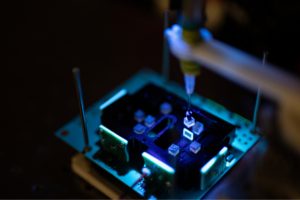
The company’s technology combines mobile robots alongside static wireless environmental sensor nodes to collect information from parts of a landscape that may be missed by satellite imagery and conventional sampling.
Jake Shaw-Sutton, director of Robotriks and lecturer in Applied Robotics at the University of Plymouth, said: “The work we are developing is about gathering better information from the environment and making that information more useful for the people responsible for managing land.
“Satellite data and traditional sampling methods can give a broad picture, but they can miss important detail.
“Our aim is to use mobile robotics and sensors to create much higher-resolution environmental maps, helping to identify issues that might otherwise go unnoticed.”
Robotriks has been exploring how environmental sensors could be mounted on mobile robots, including robot dogs and tracked vehicles, to scan land and build detailed heat maps.
These could help identify patterns relating to soil condition, crop health, chemical presence and gaseous emissions.
By collecting data closer to the ground and at a more detailed level, the technology could help land managers identify issues earlier, target interventions more effectively and build a clearer understanding of changing conditions across a site.
Full fibre connectivity from Cornwall-based broadband provider Wildanet is helping the company complete the final testing phase by enabling Robotriks to move detailed sensor readings, design files and project data rapidly between its workshop, home office and project partners.
Shaw-Sutton added: “The final stages of testing generate substantial amounts of detailed sensor data, design files and project information.
“Having dependable, high-capacity full fibre connectivity means we can transfer and review that material quickly, share findings as they emerge and keep the development process moving.
“It has made it much easier to collaborate between locations, respond quickly to what the data is telling us and prepare the technology for use in the field.
“That is particularly important for a small Cornwall-based business, with team members scattered around the South West, working on advanced technology with potential applications across rural and agricultural landscapes.”
Wildanet recently launched symmetrical full fibre broadband with speeds of up to 2Gbps in Cornwall.